
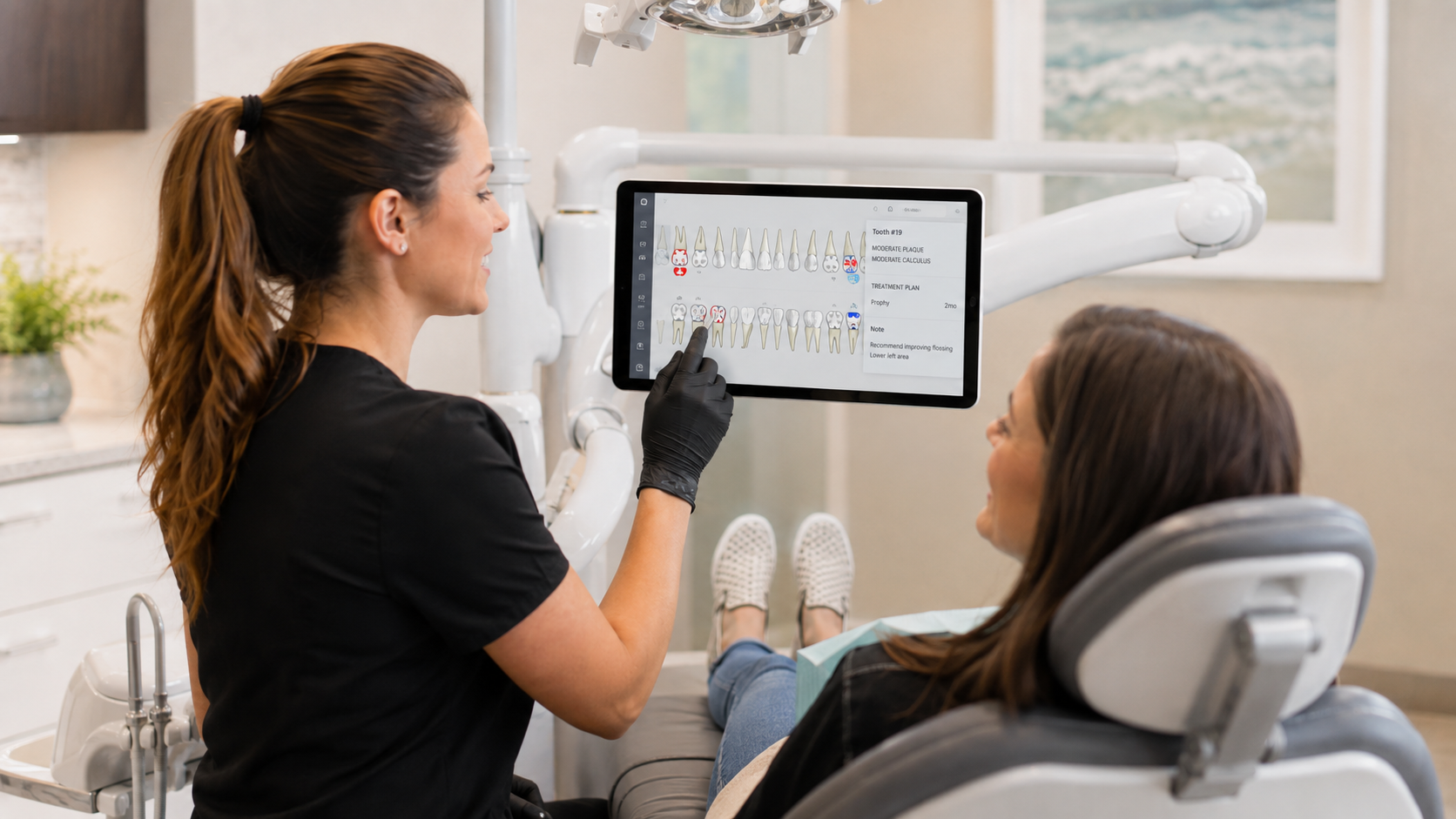
Dental treatment plan tracking gives dental teams a structured way to understand what happens after treatment is recommended. Instead of allowing planned care to disappear into individual patient records, practices can monitor what has been proposed, what has been scheduled, what remains outstanding and where follow-up may be needed.
This matters because creating a treatment plan is only one part of the patient journey.
Patients may leave without booking.
They may want time to think.
They may need to understand insurance coverage.
They may intend to call next week and forget.
Without a consistent system, the practice can lose visibility into planned care.
Better treatment plan tracking makes the next step clearer for both management and the front desk.
What is dental treatment plan tracking?
Dental treatment plan tracking is the process of monitoring recommended dental care from the point a treatment plan is created through scheduling, treatment and completion.
A treatment tracking workflow may include:
Treatment recommended → Plan created → Patient discussion → Appointment scheduled → Treatment delivered → Plan updated
But not every patient moves through that sequence immediately.
Some treatment plans remain partially completed.
Others stay unscheduled.
This is why dental treatment plan tracking needs to show status, not merely existence.
The office manager should be able to understand what has happened after the plan was created.
Why treatment plans become unscheduled
Patients may postpone treatment for many legitimate reasons.
These can include:
- Financial considerations
- Insurance questions
- Work schedules
- Family responsibilities
- Fear or anxiety
- Wanting time to consider options
- Seeking another opinion
- Travel
- The absence of immediate symptoms
- Simply forgetting to call
A patient leaving without booking does not necessarily mean the patient has declined treatment.
That makes follow-up important.
The role of dental treatment plan tracking is not to pressure a patient.
It is to prevent appropriate follow-up from relying on someone’s memory.
The hidden problem with unscheduled treatment
Imagine an office manager asks:
“How much planned treatment is currently unscheduled?”
Can the practice answer quickly?
If the answer requires opening patient records individually, asking different employees or building a spreadsheet, the practice lacks clear treatment plan visibility.
This creates several problems.
The patient may not receive consistent follow-up.
Employees may contact the same patient multiple times because previous attempts were not visible.
Treatment may remain forgotten for months.
Management may have limited understanding of how planned care is progressing.
A stronger tracking process makes treatment status visible at a practice level.
1. Treatment tracking should start inside the clinical workflow
Dental treatment plan tracking should not begin as a separate administrative project after the patient leaves.
Ideally, the process begins as treatment is charted and planned.
Clinical information and treatment planning should connect naturally.
This reduces the need for clinicians to move repeatedly between disconnected screens.
It also helps ensure that the treatment plan reflects what was discussed and documented.
For practices evaluating clinical software, this is an important point.
It is not enough to ask:
“Does the system have treatment planning?”
Ask:
“How naturally does treatment planning fit into charting and clinical notes?”
That workflow affects whether teams use the system consistently.
2. Give every treatment plan a clear status
A plan without a status is difficult to manage.
At a basic level, the practice should be able to distinguish among treatment that is:
- Planned
- Scheduled
- In progress
- Completed
- Deferred
- Unscheduled
The exact terminology may differ between systems.
The principle remains the same.
Office managers need to know where each plan currently sits.
This also makes practice-wide reporting more useful.
Instead of simply knowing that $X of treatment exists in the database, management can understand what portion is actively progressing.
3. Make treatment phases visible
Complex treatment may involve several appointments.
That creates another challenge for dental treatment plan tracking.
The patient may have completed part of the plan while other treatment remains.
A simple “scheduled/not scheduled” view may therefore be insufficient.
Treatment phase tracking helps staff understand:
- What has already been completed
- What comes next
- Which appointments are booked
- Which phase remains outstanding
- Whether the overall plan is progressing
This can make coordination easier for both clinical teams and the front desk.
4. Connect treatment planning to scheduling
Treatment plans and the appointment book should not operate as separate worlds.
Once a patient agrees to move forward, scheduling becomes the next operational step.
A connected workflow can help reduce friction between:
Treatment discussion → Appointment creation
The fewer systems or screens the employee needs to navigate, the less opportunity there is for information to be lost.
It also becomes easier to identify treatment that remains unscheduled.
This is particularly useful when cancellations occur.
Depending on clinical appropriateness and practice workflows, the team may have patients with planned treatment who could potentially use available time.
5. Build a defined follow-up process
Without a policy, treatment plan follow-up tends to happen inconsistently.
One team member calls after three days.
Another waits two weeks.
Someone else sends an email.
Some patients receive no follow-up at all.
A stronger process might define:
When the first follow-up occurs
Which communication method is appropriate
How many contact attempts are made
How responses are documented
When the treatment plan is reviewed again
The exact cadence should fit the practice and patient relationship.
Consistency is more important than choosing one universal schedule.
6. Communication should be helpful, not transactional
Treatment follow-up requires care.
Patients should not feel that the practice is simply pursuing revenue.
The purpose of communication should be to help the patient understand next steps and make an informed decision.
CDA provides patient communication resources that include guidance spanning first visits, treatment discussions and challenging conversations.
Canadian Dental Association patient communication resources
A treatment follow-up might therefore focus on:
- Whether the patient has additional questions
- Whether they need clarification about the plan
- Whether scheduling is the obstacle
- Whether another conversation with the clinical team is appropriate
Good dental treatment plan tracking supports communication.
It should never replace professional patient communication.
7. Track the follow-up itself
If several people work at the front desk, follow-up activity needs to be visible.
Otherwise, a patient might receive:
An email from one employee.
A phone call the next morning from someone who does not know about the email.
Another message several days later from a third team member.
This creates a poor patient experience.
Tracking should make it clear:
Was the patient contacted?
When?
How?
What was the outcome?
Does another action need to occur?
The practice can then create continuity even when responsibility moves between employees.
8. Treatment plan analytics can reveal larger patterns
Individual patient follow-up matters.
Practice-level patterns matter too.
Management may want to know:
- How much treatment remains unscheduled?
- How long does treatment typically remain unscheduled?
- Are particular procedure categories progressing differently?
- Is treatment plan activity increasing or declining?
- Are follow-up processes producing consistent results?
This is where dental treatment plan tracking connects to practice analytics.
The office manager does not need to search every patient record.
Instead, management can review the broader trend and decide where investigation is needed.
9. Treatment acceptance is not the only metric
Practices sometimes focus heavily on “treatment acceptance rate.”
That metric can be useful, but it needs context.
Patients have the right to make their own treatment decisions.
Not every plan should be expected to move forward immediately.
A more useful set of questions may include:
Are patients receiving appropriate information?
Do we know what remains unscheduled?
Are we following up consistently?
Are staff documenting the status clearly?
Can management see the overall pattern?
Those questions focus on the quality of the workflow rather than simply pushing one percentage higher.
10. Use analytics to identify where attention is needed
Imagine a practice has hundreds of open treatment plans.
Manually reviewing each one is not an efficient management strategy.
Analytics can help break the information into meaningful groups.
For example:
Recently planned but unscheduled
Partially completed
Outstanding for an extended period
High-priority clinical follow-up
Treatment plans with upcoming appointments
Predictive analytics can further help identify areas where patterns deserve investigation.
This makes dental treatment plan tracking more manageable at scale.
11. Connect treatment planning with insurance workflows
Insurance can influence the timing of dental treatment.
Patients may want to understand coverage before proceeding.
Some services may require estimates, supporting information or preauthorization depending on the benefit program.
For Canadian practices, the Canadian Dental Care Plan is one example.
The federal government’s current CDCP guidance notes that some services require preauthorization and that providers should review documentation requirements before submitting requests.
Government of Canada CDCP preauthorization resources
This reinforces the importance of keeping clinical information, treatment planning and administrative workflows organized.
The more complex the treatment, the more valuable clear tracking becomes.
12. Avoid managing treatment plans in spreadsheets
Spreadsheets often appear when the practice management software does not make a workflow easy enough.
An office manager exports treatment information.
Then adds status columns.
Then employees update the sheet.
Eventually, the spreadsheet becomes a second system.
That creates problems.
Information can become outdated.
Different versions may circulate.
Patient information may appear outside its primary system.
Employees must remember to update both places.
Where possible, dental treatment plan tracking should stay within the practice management environment.
The closer treatment status remains to the actual patient record, the easier it is to maintain accuracy.
13. Make clinical and administrative views work together
Dentists and office managers use treatment information differently.
The clinician may need to understand:
- Existing conditions
- Proposed care
- Clinical notes
- Treatment sequence
The office manager may need to understand:
- Appointment status
- Follow-up status
- Unscheduled treatment
- Overall treatment activity
Good software should support both perspectives without forcing teams to maintain separate versions of reality.
This is another reason unified clinical workflows matter.
14. Treatment tracking can help forecasting without pretending the future is guaranteed
Outstanding treatment can provide useful context for future activity.
But practices should avoid treating all planned treatment as guaranteed future revenue.
Patients may change their mind.
Clinical circumstances may change.
Insurance circumstances may change.
Treatment recommendations can change.
A responsible analytics approach uses planned treatment as an operational indicator rather than an absolute financial forecast.
The question becomes:
“What planned care is currently in the pipeline?”
rather than:
“How much revenue are we guaranteed to receive?”
That distinction creates more realistic management expectations.
15. Create a weekly treatment plan review
A simple weekly workflow can keep treatment plans from disappearing.
The office manager might review:
- New unscheduled treatment from the previous week.
- Treatment plans requiring patient follow-up.
- Partially completed plans.
- Plans outstanding beyond the practice’s normal follow-up period.
- Upcoming appointments related to active treatment.
- Any trends highlighted by analytics.
The review does not need to become a large meeting.
The goal is maintaining visibility.
What should dental treatment plan tracking software include?
Look for functionality that allows teams to:
- Create and update treatment plans easily
- Connect treatment planning with clinical charting
- Organize treatment by phase
- View scheduled and unscheduled care
- Track progress
- See treatment history
- Access notes and relevant patient information
- Review treatment plan trends
- Connect appropriate treatment activity to scheduling
The best system is not necessarily the one with the most fields.
It is the system employees can use consistently throughout the patient workflow.
Common dental treatment plan tracking mistakes
One mistake is creating a plan and assuming the patient will contact the practice when ready.
Another is relying on one employee’s personal reminder system.
Another is measuring only acceptance without understanding follow-up quality.
Another is separating clinical treatment planning from administrative scheduling.
And another is exporting treatment information into spreadsheets that quickly become outdated.
Each mistake has the same underlying problem:
The treatment plan exists, but the workflow around it is unclear.
Better treatment plan tracking improves more than revenue visibility
Dental treatment plan tracking is sometimes discussed purely as a financial opportunity.
That is too narrow.
A better workflow can also create:
- More consistent patient follow-up
- Better coordination between clinical and administrative teams
- Clearer appointment planning
- Less dependence on staff memory
- Better management visibility
- Easier prioritization
- A more organized patient experience
These are operational benefits.
Bring charting and treatment planning together with Paradigm
Paradigm’s unified clinical workflow brings charting, treatment planning and clinical notes together so dental teams can move between important parts of the patient record without unnecessary context switching.
Treatment plans can be organized into phases and tracked as care progresses.
At the practice level, Paradigm’s analytics can provide additional visibility into treatment plan activity alongside scheduling, patient and financial information.
That means dental treatment plan tracking does not need to become another spreadsheet or disconnected process.
It can remain part of the same practice management environment your team already uses.
Want to see how Paradigm can simplify treatment planning from the operatory to the front desk? Book a demo with our team.
Frequently asked questions about dental treatment plan tracking
Dental treatment plan tracking is the process of monitoring recommended treatment from planning through scheduling and completion.
Tracking helps practices maintain visibility and provide consistent follow-up when patients leave without scheduling recommended care.
No. Follow-up should be appropriate to the patient’s circumstances, preferences, treatment and practice policies. Tracking helps the team know what has already occurred.
Comprehensive dental practice management software can support treatment planning, status tracking, treatment phases, scheduling and reporting.
Yes. When staff can clearly see what was discussed, scheduled and followed up, conversations can be more consistent and informed.
Analytics can help management understand patterns across treatment plans, such as the amount of unscheduled care and changes over time.